
How Clinic Owners Should Use AI in Healthcare: The 3 Bottlenecks to Solve First
If you are a clinic owner trying to figure out how to use AI in healthcare, there is one mistake that will quietly waste a lot of time, money, and momentum:
Using AI to scale a business that still has friction in the foundation.
Right now, a lot of clinic owners are experimenting with AI tools for marketing, content creation, admin support, systems, and automation. On the surface, that makes sense. These tools are powerful, and in the right context, they can absolutely help you create more leverage inside your practice.
But AI is not a shortcut around weak strategy.
If your clinic is unclear in its positioning, AI can help you create more polished confusion. If your systems are disorganized, AI can help you move more people into a mess. If you are still the bottleneck in every important decision, AI may help you move faster — but not necessarily in the right direction.
That is why one of the smartest things a clinic owner can do before adopting more AI is identify the real constraint in the business.
Because the clinics that will grow best in the age of AI are not simply the ones using the most tools. They are the ones using the right tools to solve the right problem.
What Most Clinic Owners Get Wrong About AI in Healthcare
A lot of the conversation around AI in healthcare focuses on what these tools can do.
Can AI write content?
Can AI help with admin?
Can AI build SOPs?
Can AI support patient communication?
Can AI help with marketing?
The answer, increasingly, is yes.
But those are not the most important questions.
The more useful question is this:
What is the one thing in my clinic that is currently slowing growth the most?
Because if you do not know the answer to that, it becomes very easy to use AI in ways that feel productive but do not actually move the business forward.
This is where a simple business concept becomes incredibly useful.
It is called the theory of constraints.
The idea is that every business has one main bottleneck that limits how much growth the business can actually sustain. Until that bottleneck is addressed, almost every other improvement will produce less return than it should.
And that is exactly why some clinic owners can adopt all the right tools and still feel like the business is harder to grow than it should be.
The 3 Most Common Bottlenecks in a Healthcare Practice
When clinic owners feel stuck, the issue usually is not that everything is broken.
More often, one core area is creating drag across the entire business.
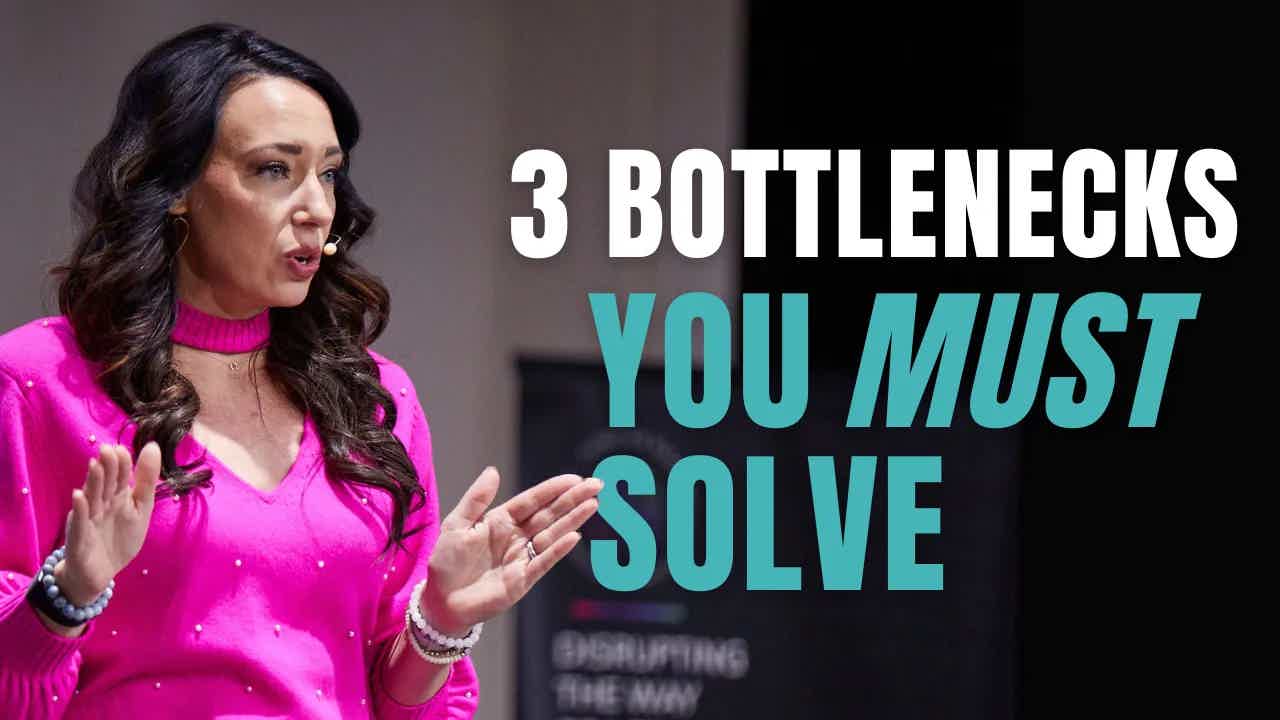
In healthcare practices, that bottleneck usually falls into one of three categories.
1. Lack of Clarity in Positioning and Messaging
This is one of the biggest hidden growth constraints in healthcare right now.
If your clinic is not clear in what it stands for, who it serves, and what it is best known for, every part of your growth strategy becomes harder.
That includes:
marketing
referrals
patient trust
content performance
brand authority
and AI discoverability
This matters more than ever because patients are no longer relying only on referrals or websites to make healthcare decisions.
They are increasingly:
searching symptoms and treatment options online
using AI tools to gather health information
comparing practitioners faster
and making trust decisions based on digital clarity
That means broad, general, “we help everyone” positioning is becoming less effective.
If you want AI, search engines, and real humans to understand your clinic, you need clarity around:
who you help
what problem you solve
what your clinic is known for
and what kind of transformation or outcome people can expect
This is also where many clinic owners stay stuck for too long, because they keep treating clarity as something to think about rather than something to decide.
But in most cases, clarity is not a brainstorming problem. It is a decision problem.
2. Operational Bottlenecks and Lack of Capacity
Sometimes the clinic does not need more visibility. It needs more operational support.
This is what happens when there is enough demand coming in, but the business is not set up to hold growth cleanly.
This can show up as:
overwhelmed front desk staff
inconsistent follow-up
weak onboarding systems
room limitations
poor internal communication
undertrained admin support
or too many operational tasks still sitting with the owner
From the outside, it often looks like a marketing issue.
From the inside, it is a systems issue.
And this is exactly where AI can be incredibly useful for healthcare businesses — not because it replaces your team, but because it helps reduce friction in the repetitive, operational parts of the clinic.
For example, AI can help clinic owners:
document SOPs
create staff training resources
draft patient communication templates
support internal workflows
improve consistency across admin systems
and reduce the amount of repetitive decision-making required to keep the clinic moving
Used this way, AI becomes a tool for operational leverage.
Not just output. Not just speed. Leverage.
And for many clinic owners, that is where the biggest opportunity sits right now.
3. Owner Dependency and Leadership Bottlenecks
This is one of the most common growth constraints in a healthcare practice, especially in founder-led clinics.
The owner is still the person everything runs through.
They are the strategist, the final decision-maker, the clinical leader, the content voice, the quality controller, and often the one carrying the standards of the entire business.
That works for a while.
But eventually, it creates a ceiling.
Because even if the clinic has demand, systems, and opportunities to grow, everything still depends on one person having the time, bandwidth, and energy to move it forward.
This is often why growth starts to feel linear. There is always a sense that once the current season calms down, then there will be time to build the next thing.
But in reality, that next level usually requires the owner to stop being the only engine in the business.
This is where AI can support leadership most effectively.
Not by replacing the owner’s expertise, but by helping reduce the number of tasks that require their direct input.
That might include:
using AI as a thinking partner for strategy
using AI agents to execute repetitive tasks
creating first drafts faster
organizing ideas more efficiently
or reducing the amount of manual work required to build systems and assets
The point is not to remove the human element from healthcare.
The point is to stop forcing the clinic owner to manually carry everything that growth depends on.
How to Use AI in a Healthcare Practice the Right Way
If you are wondering how to actually apply this inside your clinic, here is the simplest way to think about it:
Use AI to relieve pressure where your business is already constrained.
That means:
If your clinic lacks clarity, use AI to sharpen messaging and brand communication.
If your clinic lacks capacity, use AI to support systems and operations.
If your clinic depends too heavily on you, use AI to reduce manual execution and decision fatigue.
This is the difference between using AI as a distraction and using AI as a strategic advantage.
The clinic owners who benefit most from AI over the next few years will not be the ones trying every new tool.
They will be the ones who know exactly where to apply leverage.
AI is changing healthcare, but it is not changing one very important truth:
A business still grows by solving the right problem in the right order.
If your clinic feels harder to grow than it should right now, do not start by asking what new tool you need.
Start by asking:
What is the one thing in my clinic that is currently limiting growth?
Because once you identify that clearly, AI becomes much easier to use well.
And when it is applied to the right bottleneck, it can help you create more clarity, stronger systems, better leadership capacity, and a clinic that is built to grow with a lot less friction.
Want help identifying the real bottleneck in your clinic?
If you know your clinic has hit a ceiling, but you are not fully sure whether the issue is your positioning, your systems, your team, or owner dependency, this is exactly the kind of work we help clinic owners unpack.
Book a strategy call with our team and we’ll help you identify the real growth constraint so you can move forward with more clarity, leverage, and momentum.
Your Practice Shouldn't Run on Hustle Alone
If you've built consistent revenue but everything still depends on you showing up, Growth Lab is the operating system that fixes that. Coaching, done-with-you systems, community and a team that finally runs without you in every room.
See If Growth Lab Is Right For You →